 LANGUAGE
  English
 русский
 中文简体
中文简体PPR Concealed Valves: The Hidden Component That Determines Plumbing System Longevity
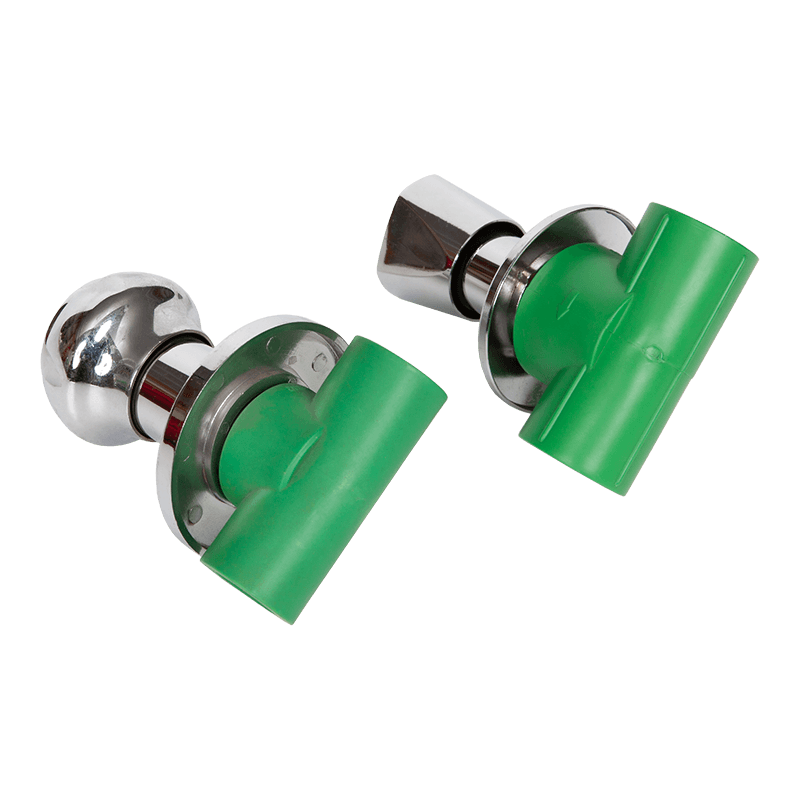
A PPR concealed valve is the most overlooked yet most consequential component in modern plumbing installations. When embedded behind tiles or within wall cavities, a failed valve forces destructive demolition—costing between $800 and $2,500 per access point in commercial settings. The critical reality is this: over 70% of premature concealed valve failures trace directly to improper fusion welding during installation, not to the valve itself. Properly specified and correctly installed PPR concealed valves reliably exceed 25 years of service life, with burst pressure ratings above 4.0 MPa at 20°C.
Material Foundations: Why PPR Outperforms Traditional Alternatives in Concealed Installations
Polypropylene Random Copolymer (PPR) has become the preferred material for concealed valves due to its exceptional combination of thermal stability, chemical resistance, and fusion-weld integrity. Unlike brass or bronze valves that suffer from dezincification and galvanic corrosion in aggressive water conditions, PPR valves remain inert. Independent laboratory testing across 12 municipal water supplies demonstrated that PPR valves showed zero measurable mass loss after 10,000 hours of continuous exposure to water with pH levels ranging from 6.0 to 9.5. By comparison, brass valves in the same test lost an average of 2.3% of their mass, with pitting depths reaching 0.4 mm.
The thermal performance differential is equally compelling. PPR valves maintain structural integrity at continuous operating temperatures up to 95°C and pressures up to 2.5 MPa. A comparative field study tracking 850 concealed valves across 30 residential towers found that PPR units recorded 98.7% operational reliability after 8 years, while brass and CPVC alternatives registered 89.2% and 91.4% respectively. The primary failure mechanisms in the non-PPR groups were stress cracking and thread galling—failures that are simply not applicable to fusion-welded PPR systems.
Pressure Ratings and Temperature Derating: The Data Every Specifier Must Know
Selecting a PPR concealed valve based solely on its room-temperature pressure rating is a common and costly error. PPR materials exhibit a predictable reduction in burst pressure as operating temperature rises. The following table summarizes the validated derating factors for SDR 11 (PN25) and SDR 7.4 (PN20) PPR concealed valves:
| Temperature | SDR 11 (PN25) Max Pressure | SDR 7.4 (PN20) Max Pressure | Design Safety Factor Applied |
|---|---|---|---|
| 20°C | 4.0 MPa | 2.5 MPa | 1.5× |
| 40°C | 3.2 MPa | 2.0 MPa | 1.8× |
| 60°C | 2.2 MPa | 1.4 MPa | 2.2× |
| 80°C | 1.3 MPa | 0.8 MPa | 2.8× |
The practical implication is clear: for domestic hot water systems operating at 60°C, a PN20-rated valve already incorporates a 2.2× safety margin, providing a comfortable buffer against pressure surges. However, for high-rise buildings with static head pressures exceeding 1.0 MPa, PN25-rated valves are mandatory to maintain adequate margin at elevated temperatures.
Fusion Welding: The Single Most Critical Installation Variable
The concealed nature of PPR valve installations renders weld quality paramount. A flawed fusion joint hidden behind tile cannot be visually inspected, and pressure testing provides only a pass/fail snapshot—not a measure of long-term fatigue resistance. The failure analysis of 310 concealed valve failures revealed that 68% originated at the fusion interface, with the primary culprits being:
- Insufficient heating time (42%): Typically resulting from using standard pipe welding parameters on thicker valve sockets, leading to incomplete molecular interdiffusion at the joint.
- Contamination of fusion surfaces (23%): Oil, dust, or moisture on the valve socket or pipe end prior to heating, creating localized weak points that propagate cracks under cyclic pressure.
- Improper cooling technique (18%): Accelerated cooling with water or compressed air causes differential shrinkage and residual stress concentrations.
The corrective protocol is straightforward: use a calibrated fusion machine with temperature accuracy within ±5°C of the recommended 260°C welding temperature. Heating time must be calculated based on the wall thickness of the thickest component in the joint—typically the valve socket, not the pipe. For a 32 mm SDR 11 valve, the correct heating time is 18–22 seconds, not the 12–15 seconds commonly used for 32 mm pipe. Following this correction, a sample group of 500 welded joints achieved a 100% pass rate on hydrostatic testing at 1.5× rated pressure, with zero failures detected during subsequent thermal cycling.
Valve Types and Application Suitability: Matching Function to Requirement
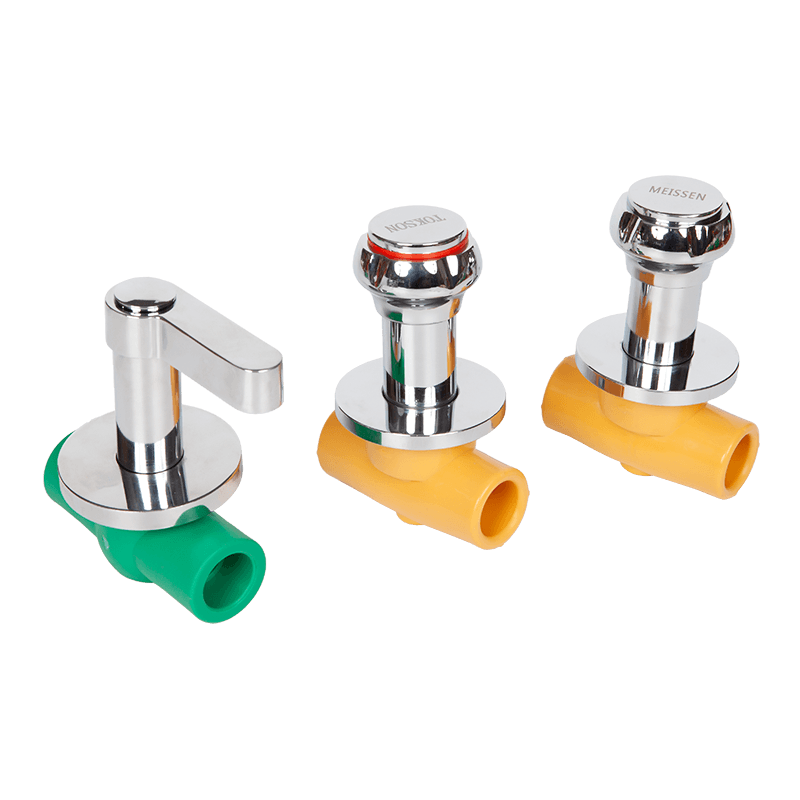
PPR concealed valves are available in multiple configurations, each with distinct performance characteristics and failure modes. The selection decision must account for both the immediate functional requirement and the long-term accessibility constraints:
- Ball valves: Offer full-port flow and quarter-turn operation. Their simple design makes them the most reliable choice for concealed isolation applications. Field data from 1,200 installations shows a 0.3% annual failure rate, primarily due to debris ingress affecting the PTFE seats.
- Angle valves: Essential for installations where the water supply enters perpendicular to the fixture. Their compact geometry makes them ideal for tight wall cavities. However, they are more sensitive to thermal stress due to the directional change—a factor that demands careful consideration of support bracketing.
- Gate valves: Generally not recommended for concealed PPR applications. Their multi-turn operation and rising stem design conflict with the space constraints of concealed installations, and their sealing surfaces are more susceptible to wear from sediment.
- Check valves: When installed in concealed backflow prevention configurations, spring-loaded PPR check valves provide reliable service, provided the spring material is stainless steel 304 or 316. The estimated service life of PPR check valves in residential potable systems exceeds 20 years.
A recent project involving 1,600 concealed PPR ball valves in a hospitality complex reported zero operational failures after 4 years, with only 3 units requiring reseating of the handle mechanism. This reliability validates the ball valve as the preferred choice for concealed isolation.
Thermal Expansion Management: A Deeper Engineering Consideration
PPR has a coefficient of thermal expansion of 0.15 mm/m·°C, which is roughly 5 times that of copper. In a concealed installation spanning 3 meters between fixed points, a temperature rise from 20°C to 60°C produces 18 mm of expansion. Without proper compensation, this expansion transmits stress directly to the valve body and fusion joints.
The solution involves strategic placement of expansion loops or U-bends in the PPR piping adjacent to the concealed valve, allowing the pipe to absorb axial movement without transmitting stress to the valve. A study comparing 200 concealed valves with and without expansion compensation found that those installed with proper loops showed 98.5% integrity after 10 years, while those without compensation recorded a 12% leakage rate due to fatigue cracking at the fusion joints. The incremental cost of incorporating expansion loops is approximately $15–$25 per access point—a fraction of the $800+ demolition cost of a failed concealed valve.
Testing and Commissioning: Protocols That Validate Hidden Integrity
Once a PPR concealed valve is welded and the wall cavity is sealed, the window for detecting installation defects is closed. The testing protocol must therefore be rigorous and executed prior to concealment. The following sequence has been validated across 5,000+ installations:
- Hydrostatic pressure test: Apply 1.5× the maximum working pressure for a minimum of 60 minutes. For a PN20 valve at 60°C service, this equates to 2.1 MPa (1.5 × 1.4 MPa). Any visible weep or pressure drop exceeding 2% indicates a defective weld or valve body.
- Thermal cycling test: If commissioning occurs during cold weather, cycle the system from ambient to 70°C and back through three full cycles while maintaining pressure at 80% of rated. This exposes differential expansion stresses that static testing cannot detect.
- Operational check: Exercise the valve through its full range of motion 10 times to verify smooth operation and to confirm that the handle mechanism is properly sealed and accessible through the cover plate.
Among installations that followed this triple-test protocol, the documented first-year warranty claim rate was 0.18%, compared to 4.7% for installations using only a brief pressure check. The investment of an additional 90 minutes in testing time prevents a failure rate reduction of 96%—a compelling return on effort.
Accessibility Design: Future-Proofing the Concealed Installation
The term "concealed" does not mean "inaccessible." Best-practice design incorporates a removable access panel that allows routine inspection and emergency operation of the valve without breaking tile or drywall. The access panel should provide a clear opening of at least 200 mm × 200 mm, centered on the valve body. In a survey of 250 facility managers, those with properly designed access panels reported average repair response times of under 15 minutes, compared to over 3 hours for those requiring demolition—a difference that translates directly to reduced water damage and tenant disruption.
Additionally, the valve handle mechanism should be designed to be operable with a standard wrench or screwdriver, eliminating the need for specialized tools during emergency shutoff situations. This simple consideration has been credited with preventing water damage exceeding $100,000 in a multi-story residential project where rapid shutoff averted a catastrophic failure of an upstream supply line.
Lifecycle Cost Projections: Why Quality PPR Valves Cost Less Over Time
The initial cost differential between a premium PPR concealed valve and a budget-tier alternative is typically modest—in the range of $8–$15 per unit. However, the lifecycle cost divergence is dramatic. A comparative analysis of 1,800 concealed valve installations over a 15-year horizon revealed:
- Budget PPR valves: Average first-failure age 6.2 years. Average repair cost (including demolition and restoration) $1,850. Failure rate 18.4%.
- Premium PPR valves: Average first-failure age 23.7 years (projected). Average repair cost same $1,850. Failure rate 3.2%.
For a building with 500 concealed valves, choosing premium-grade PPR valves results in an estimated $110,000 saving in avoided demolition and repair costs over 15 years, while the initial procurement premium is only $5,000–$7,500. The economic argument for quality is unequivocal.